The licensing question comes up on almost every Oracle EDM engagement I work on.
Not always at the beginning — which is the problem. It tends to surface mid-project, when someone in procurement or IT leadership realises that the access model they assumed they had does not actually cover what the implementation team is building. That conversation is never a good one to have six months in.
So let me walk through how Oracle EDMCS licensing actually works — what the models are, what each one is designed for, and how to figure out which one makes sense for your organisation before it becomes an issue.
First — What Oracle EDMCS Actually Is
Oracle Enterprise Data Management Cloud Service — EDMCS — is Oracle's cloud-native MDM platform. It is the governed, versioned, workflow-driven system of record for the dimension metadata that flows across your Oracle Cloud landscape. Chart of accounts. Cost centres. Legal entities. Workforce hierarchies. Product dimensions. Any reference data that more than one Oracle application needs to agree on.
When Oracle EDM is well implemented, it brings:
- A single authoritative source for every dimension member across your landscape
- Structured approval workflows for every change — nothing moves without sign-off
- Full audit trail: who changed what, when, and why
- Validated, governed data pushed to subscriber applications — EPM, ERP, HCM — from one source
- Naming rules and property validations enforced at entry, not discovered at load time
- Complete history and the ability to roll back to any prior state
That is what makes it a genuine enterprise platform, not just a dimension management spreadsheet with a workflow bolted on.
If you want Oracle's own overview of what EDMCS is and how it sits within the EPM Cloud platform, their documentation is a good starting point: Oracle EPM Cloud — Enterprise Data Management Overview
Now — here is how it is licensed.
The Two Paths: Bundled or Standalone
Oracle delivers EDMCS through two fundamentally different commercial structures.
The first is the bundled path — EDMCS is included as part of an Oracle EPM Enterprise Cloud subscription. You do not buy it separately. It is already in your EPM contract.
The second is the standalone path — EDMCS is licensed as its own Oracle Fusion Cloud subscription, independent of EPM. You can have it without EPM, alongside EPM, or instead of EPM.
Everything else — the five licensing models, the record limits, the user structures — flows from which of these two paths you are on.
Let me go through each model in order.
Model 1: Included with EPM Enterprise Cloud (Named User)
| Approximate list price | ~$500 / user / month (25-user minimum) |
| User access | Limited to your purchased EPM named users |
| Record capacity | 5,000 records |
If your organisation is already on Oracle EPM Enterprise Cloud, EDMCS is included in that subscription. No additional procurement. No separate contract negotiation. You enable it within your existing EPM environment and you are up and running.
This is the right starting point for most EPM customers who are beginning their EDM journey. It is fast, it is cost-effective — because you are not paying anything incremental — and it integrates with your EPM applications natively. Planning, Financial Consolidation and Close, Account Reconciliation — they all connect to this instance of EDMCS through the same Oracle Cloud infrastructure.
The 5,000-record limit is important to understand correctly. According to Oracle's documentation, record counts represent unique nodes across all business processes — not rows in a table, not dimension members in a single application. [1] If you have nodes that appear in multiple viewpoints, they count once. For many smaller or mid-size EPM implementations, 5,000 nodes covers everything comfortably.
Where this model reaches its boundary is when you push beyond EPM. If your organisation wants to use EDMCS to govern data that feeds ERP or HCM systems alongside EPM — extending it from a planning and reporting governance tool to a true enterprise-wide MDM platform — you will need to think beyond this model. The user access is tied to your EPM named users, which means people outside the EPM footprint cannot participate in governance workflows without a separate EPM licence.
Works well when:
- You are already on EPM Enterprise and want to start governing your EPM dimensions
- Your record volume is within 5,000 nodes
- Your data stewardship team is already within your EPM user count
- You want the fastest, lowest-friction path to enabling EDM
Worth reconsidering when:
- You are approaching or expect to exceed 5,000 records within the planning horizon
- Data governance needs to extend to users outside the EPM licensed population
- The MDM scope includes ERP or HCM dimensions beyond EPM
Model 2: EPM Add-On Records (Extension)
| Approximate list price | ~$1,500 / 1,000 records / month |
| User access | Same as EPM Enterprise named users |
| Record capacity | 5,000 base + purchased record blocks |
This is the incremental step up from the included model. Once you have grown past 5,000 records but are not yet ready to move to a standalone EDMCS subscription, Oracle allows you to purchase additional record capacity in blocks of 1,000 records per month.
The commercial logic is straightforward: you stay within your EPM contract, you stay within your EPM user base, and you add room for your data estate to grow without triggering a full licensing change.
For organisations that are actively expanding their EPM scope — adding legal entities, bringing new business units onto the platform, onboarding new EPM applications — this model gives you space to grow without committing to a larger structural change before you know where the data volume lands.
The number to keep in mind is the incremental cost. At $1,500 per 1,000 additional records per month, a deployment managing 25,000 records pays approximately $30,000 per month in record add-ons alone, on top of the underlying EPM subscription. The standalone record-based model — which I will come to shortly — uses the same per-record rate but removes the EPM user restrictions. That comparison is worth running as soon as you start adding multiple record blocks.
Works well when:
- You have outgrown 5,000 records but the overage is manageable in blocks
- You want to stay within the EPM contract and billing structure
- Your governance user base is still covered by EPM named users
- The additional record count is a transitional state, not a permanent one
Worth reconsidering when:
- Record add-on costs are approaching what a standalone subscription would cost
- The user base for governance is expanding beyond EPM
- The long-term data volume suggests you will keep adding blocks indefinitely
Model 3: Standalone EDMCS — Record-Based
| Approximate list price | ~$1,500 / 1,000 records / month |
| User access | Unlimited |
| Record capacity | Unlimited (pay per record) |
This is where EDMCS steps fully outside the EPM contract.
The standalone record-based model is its own Oracle Fusion Cloud subscription — separate from EPM, separate billing, full Oracle Enterprise Data Management functionality with no record ceiling and no restriction on who can access it. The cost structure is identical to the EPM add-on model in per-record rate, but there is no EPM subscription required, and there are no user seat limits.
That user model change is meaningful. On an EPM-bundled licence, every person who needs to participate in an EDMCS governance workflow — approving a dimension change, validating a hierarchy, acting as a data steward — needs to be an EPM named user. On the standalone record-based model, they do not. Finance teams, IT teams, HR operations, external business units — they can all be granted access without triggering an EPM seat purchase.
For mid-size organisations that are building a cross-functional data governance capability — one that reaches beyond the EPM finance team — this user flexibility is often the deciding factor.
Oracle's own documentation is explicit on this point: the standalone subscription is the path intended for production-scale deployments, while the bundled EPM model is positioned for evaluation and limited scope. [1] That framing is a useful signal about where Oracle sees each model sitting in the broader licensing architecture.
The record-based pricing works well up to a point. The standard guidance is that somewhere in the range of 40,000 to 50,000 records, the economics shift in favour of the employee-based model. I will work through that maths in a moment.
Works well when:
- Governance scope extends beyond EPM to ERP, HCM, or other systems
- The user base for data stewardship is broader than your EPM licence covers
- You do not have or do not want an EPM Enterprise Cloud subscription
- Record volumes are manageable and the per-record cost is competitive
Worth reconsidering when:
- Record volume is heading toward or above 40,000 to 50,000 nodes
- A flat-rate cost structure is preferable for financial planning purposes
Model 4: Standalone EDMCS — Employee-Based (Unlimited Records)
| Approximate list price | ~$12 / employee / month |
| User access | Unlimited |
| Record capacity | Unlimited |
| Minimum spend | 5,000 employee minimum = ~$60,000 / month floor |
This is the model that changes the conversation entirely for large enterprises.
Instead of paying per record, you pay a flat rate per employee across your organisation — and in exchange, you get unlimited records, unlimited users, and the full Oracle Enterprise Data Management platform with no constraints on how far you grow.
The practical implication is significant: once this model is in place, your MDM programme can expand its governance scope without triggering any licensing conversation. Add a new data domain — no cost increase. Add five hundred new dimension members — no cost increase. Extend EDMCS governance to a newly acquired business unit — no cost increase. The licensing cost does not move. That kind of predictability is genuinely valuable when you are running a long-term enterprise data governance programme.
The 5,000-employee minimum means the starting price is approximately $60,000 per month. For the organisations this model is designed for — large enterprises with complex, multi-system data estates — that figure needs to be evaluated against the alternative cost of managing the same data volume on a per-record basis.
Which brings us to the maths.
At $1,500 per 1,000 records on the record-based model, versus a $60,000 per month floor on the employee-based model, the crossover point sits at approximately 40,000 records. Below that, record-based is the cheaper structure. Above it, employee-based wins on cost — and the advantage compounds as records grow.
| Records Managed | Record-Based (est./month) | Employee-Based (est./month) |
|---|---|---|
| 10,000 | ~$15,000 | ~$60,000 |
| 25,000 | ~$37,500 | ~$60,000 |
| 40,000 | ~$60,000 | ~$60,000 |
| 60,000 | ~$90,000 | ~$60,000 |
| 100,000 | ~$150,000 | ~$60,000 |
| 200,000 | ~$300,000 | ~$60,000 |
The number to build your planning model around is not just your current record count — it is where your record count will be in three years. Organisations that are at 25,000 records today but are onboarding new systems, new entities, and new data domains consistently should be running that projection before locking into a per-record contract.
Works well when:
- Record volumes are at or heading above 40,000 to 50,000 nodes
- Cost predictability matters for multi-year planning
- The MDM programme is enterprise-wide with expanding scope
- Unlimited user access supports a broad governance community
Worth reconsidering when:
- Record volumes are well below the crossover and growth trajectory is flat
- Organisation size is below the minimum employee threshold
Model 5: Bundled EPM + EDM (Employee-Based, All Inclusive)
| Approximate list price | ~$40 / employee / month |
| User access | Unlimited |
| Record capacity | Unlimited |
| Coverage | All Oracle EPM Cloud products + unlimited EDMCS |
This is Oracle's all-in cloud bundle — a single per-employee price that covers the complete Oracle EPM Cloud product suite alongside unlimited EDMCS.
Planning. Financial Consolidation and Close. Account Reconciliation. Profitability and Cost Management. Tax Reporting. Every Oracle EPM Cloud application, plus unlimited Enterprise Data Management. One contract. One invoice. One commercial relationship to manage.
For organisations that are committing to Oracle EPM Cloud as their enterprise financial platform — not selectively deploying one or two applications, but standardising the full suite — this model delivers a commercial simplicity that is genuinely useful. Finance, IT, and procurement leadership all benefit from having a single Oracle cloud relationship that covers the complete EPM and MDM landscape without product-by-product licensing decisions.
The economics of this model need to be evaluated against the full breadth of EPM product usage. At approximately $40 per employee per month, a 10,000-employee organisation is looking at $400,000 per month. That figure covers every Oracle EPM product in the portfolio. For an organisation that is using — or actively planning to use — most of that portfolio, the per-product equivalent cost of licensing those applications individually is the comparison to make. For an organisation that is using two EPM products and has no near-term plan for the others, a more targeted approach is likely to be a better fit.
Works well when:
- The organisation is fully committed to Oracle EPM Cloud across all EPM products
- Billing simplicity is a priority — one rate covers everything
- The full EPM product portfolio is in use or clearly on the roadmap
- Unlimited EDMCS at no incremental cost supports the MDM strategy
Worth reconsidering when:
- EPM Cloud usage is limited to one or two products
- A standalone EDMCS subscription without full EPM coverage is a better fit
- Total spend per employee is disproportionate to the EPM platform value realised
Summary — All Five Models at a Glance
| Model | Approx. List Price | Users | Records |
|---|---|---|---|
| EPM Enterprise (Named User) | ~$500/user/month | EPM named users | 5,000 |
| EPM Add-On Records | ~$1,500/1,000 records/month | EPM named users | 5,000 + blocks |
| Standalone — Record-Based | ~$1,500/1,000 records/month | Unlimited | Unlimited |
| Standalone — Employee-Based | ~$12/employee/month | Unlimited | Unlimited |
| Bundled EPM + EDM | ~$40/employee/month | Unlimited | Unlimited |
How to Check Your Actual Record Count in Oracle EDM
Before you can evaluate which licensing model makes sense, you need to know your actual record count. Oracle EDM makes this straightforward — but there is a distinction in the report that matters for licensing purposes, and it is easy to misread.
There are two ways to get to this number, and it is worth knowing the difference between them.
Option 1 — Reports → Record Count Log (System section, left-hand navigation)
This is the full report. It shows your record count and node count broken down by Application and Dimension, with a Record Count Contribution column for each. Use this when you need to understand where your record count is concentrated — which applications are consuming the most, which dimensions are driving growth, and where to look if you are approaching a limit.
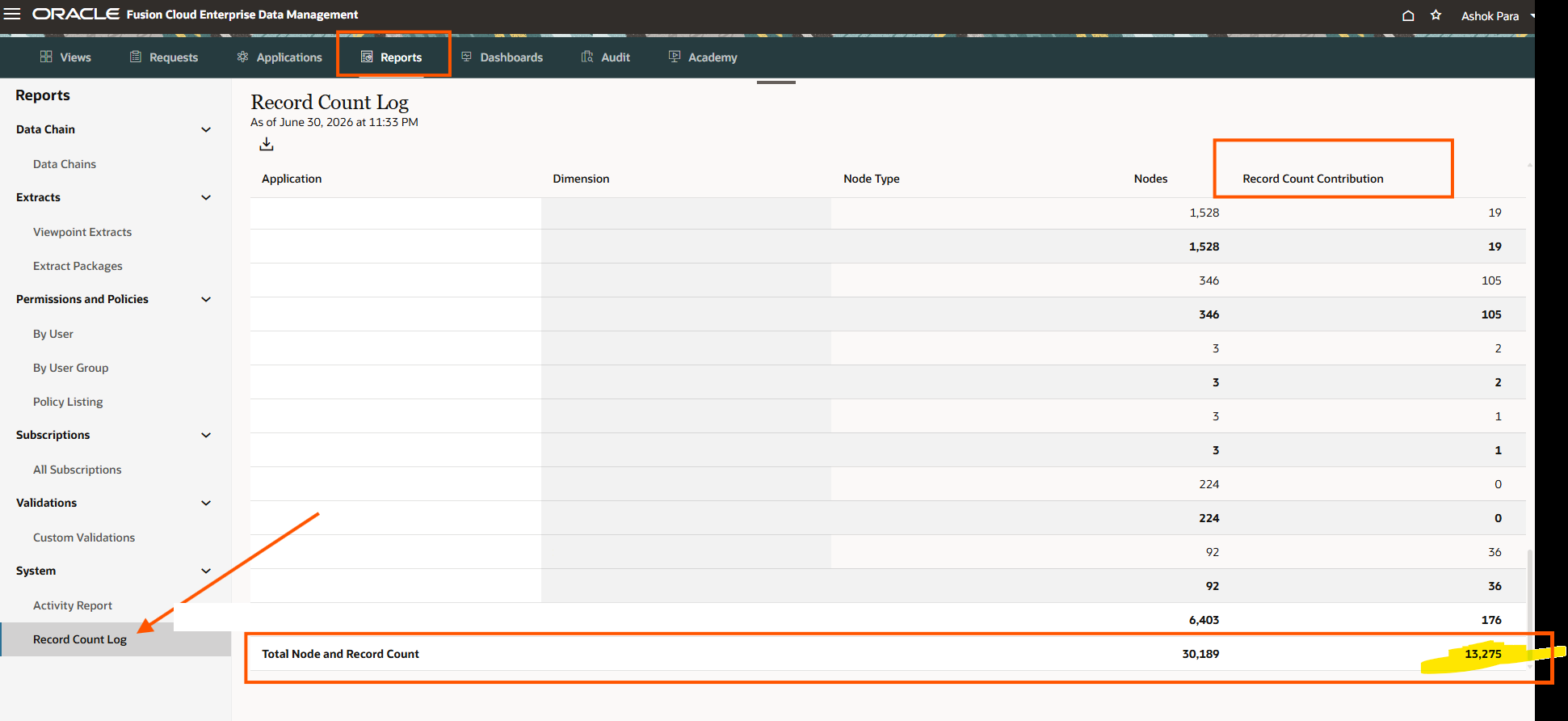
The report shows two columns that look similar but mean different things:
- Nodes — the total number of nodes across your dimensions and applications, including duplicates where the same node appears in multiple viewpoints
- Record Count Contribution — the unique node count that actually contributes to your licensed record count
The Record Count Contribution figure is what matters for licensing. Oracle counts unique nodes once regardless of how many viewpoints they appear in — so a node shared across five viewpoints still counts as one record.
Option 2 — Your username (top right) → About → Subscription
This is the quick view. It shows the same two headline figures — Record Count and Total Nodes — without the application or dimension breakdown. If you just need to know where your total sits right now, this is the fastest path. It is also where Oracle's own definition of record count appears: "a count of unique nodes across all applications grouped by business domain."
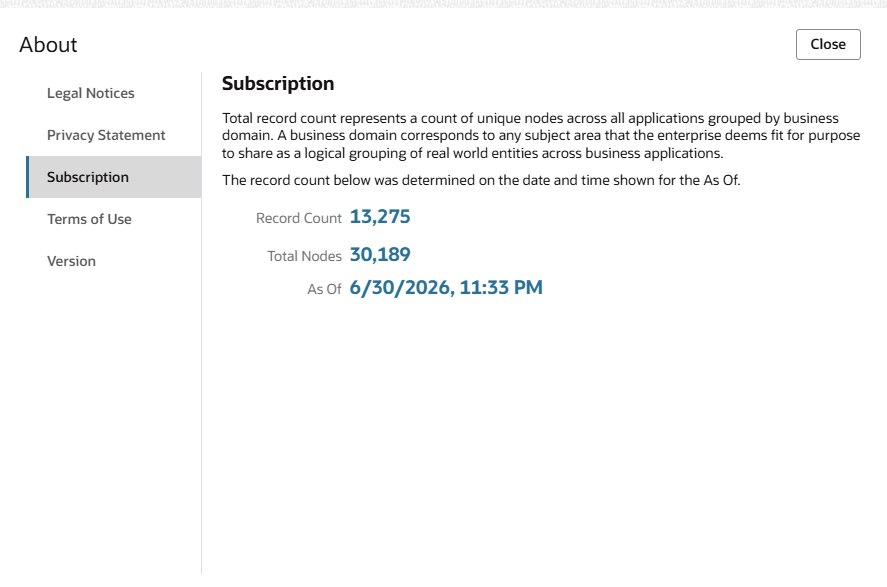
To illustrate why the distinction between these two figures matters: a deployment with 30,189 total nodes might carry a Record Count of only 13,275 — less than half the raw node figure. If you estimated your licensing position based on total nodes, you would significantly overstate where you sit against any record-based limit.
The practical step: before any licensing conversation with Oracle, pull your Record Count figure — not your total node count. Then project where that number will be in 12, 24, and 36 months based on your implementation roadmap. That projection is the input you need to make a confident licensing model decision.
How to Think Through the Decision
In practice, the licensing decision comes down to four questions. I find it useful to work through them in order.
Question 1: Are you already on Oracle EPM Enterprise Cloud?
If yes, EDMCS is already in your contract. Enable it, understand the 5,000-record ceiling, and assess whether that covers your current use case. If it does, start there. If you are already beyond that threshold or clearly heading there, move to Question 2.
If you are not on EPM Enterprise, you are on the standalone path by definition. Go to Question 3.
Question 2: How many records will you manage — today and in three years?
Under 5,000 — the included EPM model covers you. Above 5,000 but below the crossover point — evaluate whether EPM add-on blocks or standalone record-based is the more sensible structure. Once you are heading toward 40,000 to 50,000 records, run the employee-based comparison.
Question 3: How broad is your governance user base?
If EDMCS governance is confined to your EPM-licensed finance team, the EPM-bundled models work. If data stewardship needs to extend to IT teams, HR, operations, or any function outside the EPM user population, the standalone models remove that friction without adding per-seat cost.
Question 4: How committed are you to the full Oracle EPM Cloud suite?
If you are standardising on Oracle EPM Cloud across all products — or clearly on that trajectory — the bundled model is worth modelling. If your Oracle relationship is more selective, targeted standalone licensing is likely to be a better commercial fit.
One Thing to Be Clear About on Pricing
Every figure in this article is an approximate Oracle list price — a reference point for understanding the structure, not a quote.
Your actual pricing will be determined by your Oracle sales representative and will depend on your organisation's size, your existing Oracle commercial relationship, contract term, volume, and the negotiation that happens between your procurement team and Oracle's account organisation. Large enterprises routinely see meaningful movement from list prices. Multi-year commitments carry their own commercial dynamics. Bundling additional Oracle Cloud services changes the conversation further.
The right thing to do — once you have used this article to identify which model is the right structural fit — is to take that model to your Oracle account team and get pricing specific to your organisation. The list prices give you the framework. The Oracle sales conversation gives you the number.
The Bottom Line
Oracle EDMCS is the right foundation for enterprise dimension management — whether you are governing EPM data for a finance team, managing the metadata that flows through your ERP, or building a cross-functional MDM platform that spans your full Oracle Cloud landscape.
Getting the licensing model right matters because it determines not just what you pay, but how far your governance programme can reach — how many users can participate, how much data you can govern, and whether your licence scales with your programme or constrains it.
For organisations starting out on EPM Enterprise, start with what you already have. For mid-size organisations building beyond EPM, the standalone record-based model gives you the user flexibility to build a proper governance community. For large enterprises with growing data estates, run the employee-based maths before committing to per-record pricing. And for organisations going all-in on Oracle EPM Cloud, the bundled model is worth a serious commercial evaluation.
If you are in the middle of this decision on an active engagement and want to talk through the specifics, reach out. The model choice is almost always clearer once you map it to actual record projections and a concrete user list.
Connect with me if you are working through Oracle EDM licensing decisions or building an enterprise data governance programme on Oracle Cloud. Always happy to work through the specifics.
References and Disclosure
[1] Oracle Enterprise Data Management Cloud Service — EPM Cloud Getting Started with Oracle Enterprise Performance Management Cloud for Administrators https://docs.oracle.com/en/cloud/saas/enterprise-performance-management-common/cgsus/1_epm_cloud_overview_dmcs.html
This article references Oracle's public documentation for technical accuracy on record counting methodology and deployment model positioning. All interpretation and commentary is my own, based on implementation experience. Oracle's documentation is the authoritative source for current product specifications — check there for the latest.
All pricing figures are approximate Oracle list prices as of 2026, provided for illustrative purposes only. They are not quotes. Final pricing is determined by your Oracle sales representative based on your organisation's specific contract terms, volume, and commercial relationship with Oracle.